LogoRLU.AI
  • AI Photo Styles
  • Pricing
  • Blog
  • Contact
LogoRLU.AI

Transform your photos with AI. Discover the ReaL U - RLU.AI

Email
Featured on:
aibesttop AI Tools Directory|Featured on ShowMeBestAIFeatured on toolfame.comNextGen Tools BadgeFeatured on Dofollow.ToolsFeatured on saasfame.comAMZdir|Featured on findly.tools
Popular AI Styles
  • All AI Styles
  • AI Age Progression
  • Corporate Headshots Generator - AI Executive Headshot & Professional Business Portrait Maker
  • AI Headshot Background Generator - Professional Headshot Background & Red Background Portrait Maker
  • What to Wear for Professional Headshots - AI White Shirt Professional Headshot Generator
  • Grey Headshot Background - AI Gray Background Headshot & Neutral Background Generator
  • Business Casual Headshots - Free AI Casual Headshots & Casual Corporate Headshots Generator
AI Tools
  • Eyes Follow Mouse
  • AI Headshot for LinkedIn
  • AI Headshot Safety Checker
  • Casual LinkedIn Headshot
  • How to Take a LinkedIn Headshot
  • How to Take a Professional Headshot at Home
  • How to Take a Professional Headshot with iPhone
  • Headshot Prep Planner
  • What to Wear for LinkedIn Headshot
  • Medical Professional Headshots
  • Professional Headshots for Acting
  • Professional Headshot Booth Planner
  • Professional Headshot Cost Estimator
  • Professional Headshot Editing Tips
  • Professional Headshot Guidelines
  • Professional Headshot Pose
  • Professional Headshot Lighting Setup
  • Prompt for Professional Headshot
Resources
  • Pricing
  • Blog
Company
  • Contact
  • Partners
  • Waitlist
Legal
  • Privacy Policy
  • Terms of Service
© 2026 RLU.AI All Rights Reserved.Climate CommitmentTinyLaunch BadgeFeatured on ToolPilot
Hybrid Mode · Tool First

Professional Headshot Pose

Solve pose anxiety first: run an instant checker, get correction actions, then confirm trust with evidence and risk analysis on the same URL.

ToolSummaryMethodEvidenceCompareRiskFAQ
Pose input workspace

Define your usage context and pose intent. The checker returns a deterministic score in under 1 second.

Upload your photo

Drag and drop or click to browse

Supported formats: JPG, PNG, WEBP (Max 10MB)

Tip: pose scoring needs one uploaded sample. You can still review the report sections without upload.

Needs compact framing with instant trust in a small circle crop.

Quick presets

4

Deterministic mode enabled: core checker works without external AI calls.

Pose result and action plan

Review score, interpretation, boundary flags, and next-step actions.

Run the checker to see your pose score

You will get score breakdown, correction checklist, and copy-ready prompt pack.

Executive summary

Decision summary

Core conclusions, key numbers, and suitability boundaries.

12 in vs 5 ft

Camera distance can reshape facial geometry before pose adjustments even start.

A JAMA Facial Plastic Surgery model (published 2018-03-01) estimated that a 12-inch selfie view can increase perceived nasal breadth by 30% in males and 29% in females, while a 5-foot portrait distance shows nearly no difference.

This is a geometric projection model, not a universal attractiveness rule; expression and lighting still need separate validation.

400x400+

Platform acceptance gates are hard constraints, not optional polish.

LinkedIn Help requires profile photos between 400x400 and 7680x4320 (max 8MB, JPG/PNG), and LinkedIn profile-photo guidelines require the image to reflect your likeness.

Passing platform specs does not guarantee trust outcomes, but failing them blocks delivery regardless of pose quality.

n=610

Who selects the final photo can materially change first-impression quality.

A 2017 peer-reviewed study in Cognitive Research (two internet studies, n=610) found other-selected profile images produced more favorable impressions than self-selected images.

The effect is directional, not absolute; use reviewer voting as a decision aid, not the only approval gate.

2025-03-05

Camera setup quality is also a fairness and reliability control point.

NIST FRTE demographics summary (table updated 2025-03-05) states false negatives are strongly dependent on image quality, and camera misadjustment for very tall/short people can introduce pitch-angle variation.

NIST findings come from biometric evaluation contexts; apply them here as risk controls for automated checks, not as direct hiring outcome claims.

Shoulder range

15°-30° is usually the most stable range.

0°15°30°45°shoulder turn range

Chin cue

Prefer micro-adjustments; avoid over-correction.

chin cue

Eye-line consistency

Eye-level camera typically reduces distortion risk.

camera line

Applicable / not-applicable boundaries

ScenarioMore suitableNot idealCondition
LinkedIn profile refreshEye-level + 15° shoulder turn + soft smileLow camera + 45° turn + full smileBest for first impression and recruiter-facing trust.
Executive bio / board pageEye-level + 30° turn + neutral engaged expressionHigh camera + exaggerated grin + prop-heavy framingMaintain authority but avoid defensive crossed-arm framing.
Healthcare practitioner directoryEye-level + 15° turn + soft smile + level chinStrong side angle with intense starePrioritize calm, clear, and friendly eye-line communication.
Creative portfolio profileSlightly-high camera + 30°-45° turn + controlled smileFlat square pose with blank expressionAllow style variance but keep eyes and jawline readable.
Company-wide team standardizationUnified 15° or 30° turn preset across teamMixed angles and mixed expression rules by individualUse one preset family and enforce output QA checklist.
Passport / visa / regulated ID photoFrontal face, no tilt, minimal expression variance, no AI editsCreative shoulder turn, heavy expression styling, beautify filtersU.S. passport guidance explicitly bans AI/filters and requires facing the camera; this page should be treated as planning aid, not compliance override.

Need a quick go/no-go before reading the full report?

Run the checker now. If your score is below 85, continue with the method and evidence sections for targeted fixes.

Run pose check nowReview headshot guidelines
Method

Method and rubric

How the deterministic pose score is calculated and interpreted.

Deterministic scoring flow

inputsscoreactionsdecisionretake loop when score is unstable

Score band interpretation

85-100: High confidence; proceed to final review.
72-84: Usable with 1-2 targeted fixes.
58-71: Caution; retake before publishing.
0-57: Do not publish; fix baseline inputs first.

Rubric weight table

DimensionDescriptionWeight
Camera height alignmentEye-level framing is the primary baseline for trust-focused portraits.20%
Shoulder turn controlSmall to medium turn usually keeps contour and readability balanced.22%
Chin structure cueForward/down cue helps reduce jawline collapse in camera flattening.18%
Expression-context matchExpression should match platform intent instead of personal habit only.16%
Industry fitConservative industries tolerate less experimental posing variance.12%
Execution readinessUpload quality, rights confirmation, and retake willingness improve reliability.12%

Collect context signals

Capture context, style intent, industry, and pose controls in a structured form.

Input: Context + style + camera + shoulder + expression + chin cue

Output: Normalized scoring inputs

Apply deterministic rubric

Each rubric dimension contributes weighted points; conflict combinations trigger deductions.

Input: Rubric weights + conflict rules

Output: Pose score and confidence band

Generate correction actions

Translate low-scoring dimensions into concrete one-step corrections.

Input: Score breakdown + boundary flags

Output: Checklist, summary, and prompt pack

Decision gate and fallback

When score band is unstable, the page returns minimal retake path instead of overconfident output.

Input: Score band + retake readiness

Output: Go / caution / stop recommendation

Evidence

Evidence and boundaries

Source-backed facts, confidence level, and known unknowns.

Stage1b gap audit and remediation status

Published 2026-02-16Updated 2026-02-16

Closed items include traceable sources; rows marked pending/no reliable public data are kept as hypotheses, not hard conclusions.

GapImpactActionStatus
Shoulder-angle recommendations relied heavily on blog-level practice notes.Could overstate pose confidence without separating geometry distortion from styling preference.Added peer-reviewed camera-distance evidence (JAMA 2018) and NIST quality/pitch risk context to tighten scope.Closed in stage1b
Regulatory and platform authenticity boundaries were under-specified.Users could apply creative pose guidance to compliance-sensitive photos.Added LinkedIn policy details, Google Business “represent reality” rule, and U.S. passport no-AI-edit constraints with dates.Closed in stage1b
No source-backed guidance for selecting the final frame among multiple takes.Teams may rely on subjective self-selection and miss stronger first-impression outcomes.Added 2017 Cognitive Research evidence (n=610) showing other-selection can outperform self-selection.Closed in stage1b
No reliable public causal benchmark links pose angle directly to hiring conversion uplift.Any direct “angle => conversion%” claim would be overconfident.Explicitly marked as pending and retained only as an experiment hypothesis.Pending: no reliable public data
Platform policyAccessed 2026-02-16 · page label: Last updated 1 year ago

LinkedIn Help: Photo upload specifications

Defines upload constraints for profile photos (dimensions, max size, file type).

Confidence: High

Platform policyAccessed 2026-02-16 · page label: Last updated 1 year ago

LinkedIn Help: Profile photo guidelines and conditions

Requires that profile photos reflect your likeness and lists disallowed image types.

Confidence: High

Platform policyAccessed 2026-02-16

Google Business Profile Help: Photo guidelines

States resolution and file-size limits, and requires photos to represent reality without excessive alterations.

Confidence: High

Government guidanceLast updated 2025-12-15 · accessed 2026-02-16

U.S. Department of State: Passport photo requirements

Requires recent photos, direct camera-facing pose, and explicitly forbids AI/software alteration.

Confidence: High

Peer-reviewed studyPublished 2018-03-01 · accessed 2026-02-16

JAMA Facial Plastic Surgery: Nasal distortion in short-distance photos

Quantifies how short selfie distances change perceived facial proportions versus portrait distance.

Confidence: High

Peer-reviewed studyPublished 2017-04-14 · corrected 2021-08-13 · accessed 2026-02-16

Cognitive Research: The curse of self in profile image selection

Across two internet studies (n=610), other-selected profile images generated more favorable impressions than self-selected ones.

Confidence: High

Government benchmarkTable last updated 2025-03-05 · accessed 2026-02-16

NIST FRTE demographics: quality and pitch-angle risk notes

Documents that false negatives depend on image quality and camera misadjustment can induce pitch-angle variation.

Confidence: High

Key evidence table

ClaimData pointBoundarySourceObserved
LinkedIn profile photos have explicit minimum dimensions.LinkedIn Help states 400x400 to 7680x4320 pixels, max 8MB, JPG/PNG.Technical compliance is necessary for publishing, but not sufficient for trust perception.LinkedIn HelpAccessed 2026-02-16 · page label: Last updated 1 year ago
LinkedIn requires profile photos to reflect the user’s likeness.The policy lists removals for non-likeness content such as logos, emojis, landscapes, animals, or other people’s likenesses.Likeness rules are moderation requirements; they do not define one universal “best” pose.LinkedIn profile photo guidelinesAccessed 2026-02-16 · page label: Last updated 1 year ago
Google Business Profile enforces authenticity in business photos.Guidelines state photos should have no significant alterations or excessive filters and should represent reality.This policy is specific to Google Business Profile; other platforms may set different moderation thresholds.Google Business Profile HelpAccessed 2026-02-16
Regulated ID-photo workflows prohibit AI beautification and require frontal capture.U.S. passport guidance says photos must be recent (last 6 months), directly face the camera without head tilt, and not be altered by software/apps/filters/AI.This is compliance guidance for passport photos and should not be over-generalized to every corporate portrait use case.U.S. Department of StateLast updated 2025-12-15 · accessed 2026-02-16
Short camera distance can materially distort perceived facial structure.A JAMA model reported that at 12 inches, perceived nasal breadth increases by about 30% (male) / 29% (female); at 5 feet, difference is essentially negligible.The paper models geometric distortion, not downstream outcomes such as callback or conversion rates.JAMA Facial Plastic Surgery (PMC)Published 2018-03-01 · accessed 2026-02-16
Self-selection bias can reduce profile-photo effectiveness.In two internet-based studies (n=610), other-selected images generated more favorable impressions than self-selected images.This finding supports adding external review, but does not replace final owner approval.Cognitive Research (PMC)Published 2017-04-14 · corrected 2021-08-13 · accessed 2026-02-16
Camera setup quality affects error rates and can amplify demographic differentials in automated systems.NIST notes false negatives are strongly dependent on image quality, and camera misadjustment for very tall/short subjects can induce pitch-angle variation.Evidence is from biometric evaluation, so this page uses it as risk control guidance for automated scoring.NIST FRTE demographicsTable last updated 2025-03-05 · accessed 2026-02-16

Evidence gaps and next actions

TopicStatusAction
Causal link between pose angle and hiring conversion upliftPending: no reliable public causal datasetRun controlled A/B tests by role and platform before claiming percentage lift.
Demographic differences in preferred pose stylePartial evidence only; benchmark not stableCollect anonymized reviewer outcomes by demographic cohorts and re-tune presets quarterly.
Automated overlay accuracy for pose correctionPending: no open benchmark found in authoritative sourcesKeep deterministic rubric as default and tag AI overlay outputs as assistive only.
Outcome difference between short headshot video and still imagePending: no reliable public cross-platform benchmarkTrack profile views, connection requests, and reply rates by media type in your own workflow.
Tradeoffs

Alternatives comparison

Compare this page with article-only, video-only, and studio-only paths.

Path comparison table

DimensionThis hybrid pageArticle-onlyVideo-onlyStudio-only
Evidence tier transparencyMixes policy + government + peer-reviewed sources with timestampsOften expert opinion without explicit evidence tier labelingVisual examples, source provenance often unclearStrong practical guidance, documentation quality depends on studio
Policy and compliance guardrailsIncludes LinkedIn/Google/State-policy boundaries near decision outputUsually discusses style tips first, compliance notes are scatteredPolicy risk may be implicit and easy to missCan handle compliance when brief is explicit; otherwise highly photographer-dependent
Final-photo selection bias controlAdds external-review recommendation from n=610 evidence and copy-ready checklistTypically leaves final selection to personal judgmentGood for technique, weak on objective final-selection workflowCan be robust if studio provides proof-sheet review process
Distance distortion controlSeparates short-distance distortion risk (12 in) from pose micro-adjustment adviceDistance/lens caveats may be present but often non-quantifiedVisual demonstration helps, but hard to preserve as team SOPUsually controlled by photographer setup, but costs more
Cost / speed tradeoffLow cost, high speed, medium certaintyLowest cost, slower trial-and-errorLow cost, moderate speedHigher cost, highest certainty

Cost-certainty scale

This page targets fast feedback with medium certainty.

articlevideohybridstudio

Selection recommendation

  • - Use this page to converge pose quickly before formal shooting.
  • - For maximum certainty, bring this page output into studio direction.
  • - For urgent profile updates, this page covers most decisions alone.
Risk

Risk and mitigation

Avoid pose misuse, context mismatch, and compliance mistakes.

Risk matrix visualization

low impacthigh impactlow probabilityhigh probability

Risk details and mitigations

RiskProbabilityImpactMitigation
Short camera distance distorts facial proportionsHighHighSet capture distance closer to portrait range (~5 ft / 1.5 m) before judging micro-pose quality.
Over-edited or non-likeness photos fail platform or regulated reviewMediumHighRun a compliance pass: likeness check + file specs + no AI/filter edits for regulated use.
Uneven camera setup quality introduces demographic error differentials in automated checksMediumHighStandardize camera height, exposure, and retake protocol; keep human final review before publish.
Self-selected “favorite” frame underperforms in first impressionHighMediumUse 3-person blind voting (owner + peer + outsider) before locking final frame.
Decision based on one frame onlyHighMediumRetake 3-5 frames and keep best-scoring variant for final review.
Scenarios

Scenario playbooks

Concrete examples with premise, process, and output impact.

Startup founder updating LinkedIn before fundraising

Premise

Needs to look confident but not intimidating for investor and hiring audiences.

Process

Applied LinkedIn confidence preset, corrected camera to eye-level, reduced shoulder turn from 45° to 15°.

Outcome

Pose score moved from watch band to good band with fewer boundary flags.

Clinic team refresh for doctor directory

Premise

Goal is calm trust, consistent team visuals, and low re-shoot rate.

Process

Used healthcare preset, locked soft smile and 15° turn for all staff, then ran per-person checklist.

Outcome

Consistency improved and review cycle shortened because style debates dropped.

Consultant speaker bio for conference landing page

Premise

Needs authority with accessible expression for mixed audiences.

Process

Started from executive preset, replaced neutral expression with soft smile after risk check.

Outcome

Maintained authority while reducing "too strict" feedback in internal review.

Creative director portfolio update

Premise

Wants more personality than classic corporate headshots.

Process

Used creative preset with 45° turn, then reduced to 30° when eye-line consistency dropped.

Outcome

Balanced uniqueness and readability for website + LinkedIn reuse.

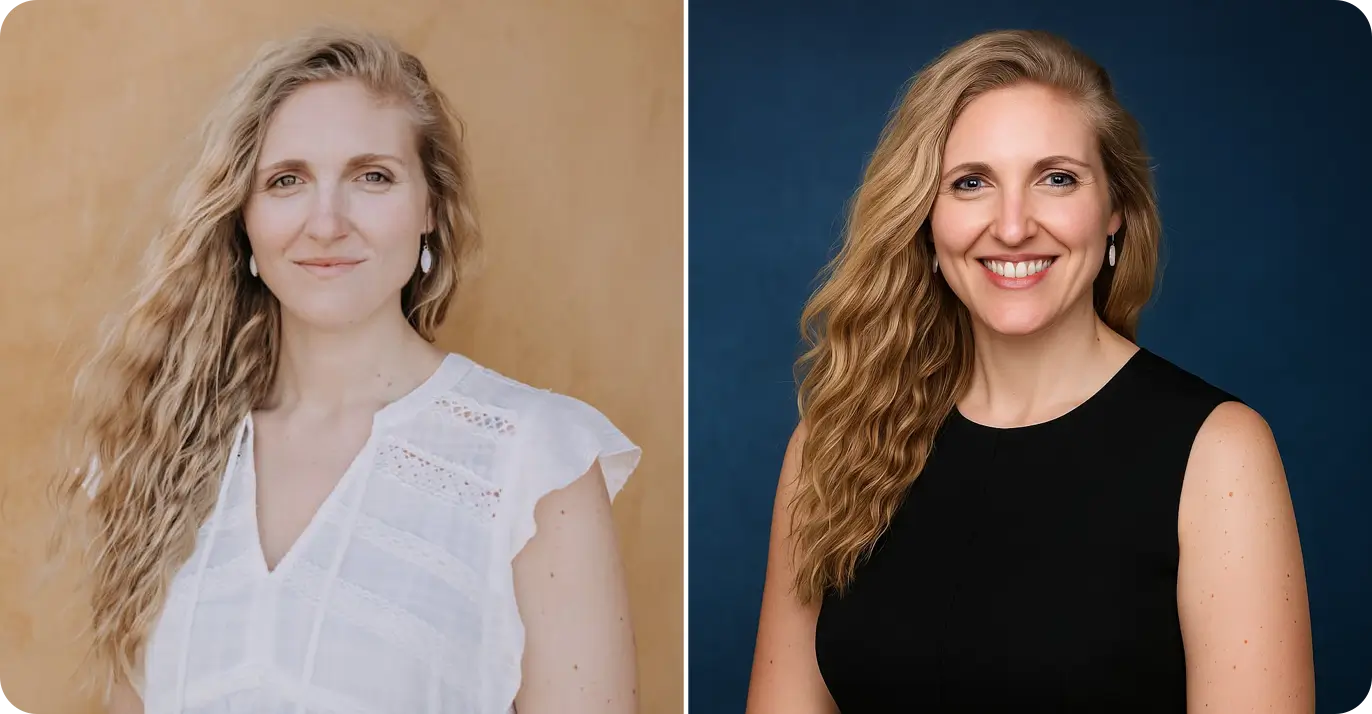
Professional headshot pose examples

Compare pose variations before locking your final publish version.

Professional headshot pose example 1 - before
Before
Professional headshot pose example 1 - after
After

Pose comparison example 1

Workflow

How to use this page

Three practical steps from pose setup to final decision.

  1. 1Step 1

    Select context and pose intent

    Choose usage context, style target, and basic pose controls before scoring.

  2. 2Step 2

    Run score and apply micro-fixes

    Generate score, review boundary flags, and apply 1-2 priority corrections.

  3. 3Step 3

    Validate with report layer

    Check evidence, risk matrix, and comparison table before final publishing.

FAQ

FAQ

Answers covering do/know intent, risks, and execution details.

Back to tool

More tools

Related tools

Continue to lighting, editing, and headshot generation workflows.

AI Headshot for LinkedIn

Move from pose planning to full LinkedIn-ready headshot generation.

Professional Headshot Guidelines

Validate platform requirements, governance rules, and team policy baselines.

Professional Headshot Lighting Setup

Pair pose quality with lighting consistency before final shooting.

Professional Headshot Editing Tips

Add natural editing guardrails once pose and lighting are validated.

Headshot Prep Planner

Prepare wardrobe, timing, and session logistics before shooting day.

Professional Headshot Cost Estimator

Estimate budget impact after your pose strategy is locked.

Ready to lock your professional headshot pose?

Use this score as your baseline, then move into full generation once pose confidence is stable.

Run pose check againOpen AI styles