8x10 @ 300 dpi+
8x10 remains the print baseline
Backstage still recommends 8x10 and at least 300 dpi for actor headshots.
Get casting-ready look variations first, then validate specs, risks, and tradeoffs with a research-backed report layer.
Set look strategy and submission constraints before generation.
Drag and drop or click to browse
Supported formats: JPG, PNG, WEBP (Max 10MB)
Quick presets
4Deterministic mode: this planner works without external AI calls.
Review score, look variants, and next actions with clear assumptions.
Run the planner to preview your pack
You will get look variants, format matrix, and risk-aware submission notes here.
Core conclusions and key numbers before you dive into full evidence.
Research updated
2026-02-18
This iteration adds platform-rule evidence, California digital-replica boundaries, and federal-policy gap findings.
Mid CTA: return to generation, then check pricing
Use this after the evidence block to move from analysis to action.
8x10 @ 300 dpi+
Backstage still recommends 8x10 and at least 300 dpi for actor headshots.
360x360 min -> 500x700 optimal
Actors Access, Casting Networks, and IMDbPro enforce different limits, and Casting Networks also caps media at 10 files per request.
24h - 2.5 weeks
Public pricing pages show anything from 24-hour delivery to 2-2.5 week retouch turnaround.
$250+ / look
Backstage cites actor headshot sessions commonly starting around $250 per look.
200 images max + cancel removes uploads
IMDbPro disallows fully AI-generated profile photos and states uploads tied to membership can be removed after cancellation.
AB 2602 signed Sep 17, 2024
California AB 2602 makes certain digital-replica clauses unenforceable when use is not specific and representation safeguards are missing.
USCO recommends new federal law
The U.S. Copyright Office reports patchwork protections and recommends federal digital-replica legislation.
Look balance visualization
Platform coverage map
Good fit: urgent audition windows
You need a structured fallback path when turnaround pressure is high.
Good fit: multi-platform submissions
One pack can prepare platform-specific crops and file constraints together.
Good fit: actor-agent review loops
Copy-ready summary/checklist shortens review iterations.
Not fit: unclear image rights
Do not proceed until rights and consent are explicit.
Not fit: extreme face alteration goals
Large facial edits increase mismatch and credibility risk.
Not fit: only one “perfect” shot needed
Casting outcomes usually need multiple role-specific variants.
How this page computes outcomes and where each requirement comes from.
Method flow (encoded SVG)
1. Normalize role and platform inputs
Map look direction, role type, and target platform into deterministic scoring factors.
2. Compute readiness score
Score quality, policy alignment, and delivery feasibility from 0-99.
3. Expand look variants
Generate at least three role-oriented variants with expression and lighting notes.
4. Validate platform formats
Cross-check platform-specific rules and mark unknown constraints explicitly.
5. Check policy and jurisdiction gates
Verify platform AI policies, membership dependencies, and jurisdiction-specific digital replica limits before launch.
6. Gate by risk boundaries
If retouch, policy, or turnaround risks exceed threshold, trigger mitigation actions first.
Platform specs with known/unknown boundaries
| Platform | Image spec | File rules |
|---|---|---|
| Actors Access | Optimal 500 x 700 px | Photo upload on profile flow with staged crop steps. Known optimal size and process flow. Hard max file size is not listed in this article. |
| Casting Networks | Minimum 360 x 360 px | Accepted JPG/JPEG/GIF/PNG, max 30 MB, and up to 10 media files per request. Known min size, max file size, and request-level media cap. No fixed aspect ratio requirement shown. |
| IMDbPro / IMDb profile | At least 500 px wide | GIF/BMP/PNG/JPEG; max 25 MB; no watermarks/logos; profile photos must not be fully AI-generated. Known file limits and AI policy. Upload controls depend on active IMDbPro membership. |
| Central Casting (background) | Basic profile snapshots (not polished headshots) | Photos can take 5-10 business days for approval and cannot be changed once approved. Counterexample boundary: professional headshots are explicitly discouraged for this workflow. |
| In-person print handoff | 8 x 10 inches, vertical orientation | At least 300 dpi; resume commonly attached on back. Known print baseline; submission venue can add custom requirements. |
| General digital submission | Vertical headshot crop | Compressed JPEG/JPG/PNG recommended. Known recommended file formats; no universal max size published. |
Policy boundary and applicability matrix
| Boundary | Trigger | Requirement | Applies to | Evidence |
|---|---|---|---|---|
| IMDbPro profile governance As of 2026-01-13 | Uploading primary profile images on IMDbPro | Fully AI-generated profile photos are not allowed. Images must be >=500px wide, <25MB, and free of watermarks/logos. | Applies directly to IMDb/IMDbPro profile photos and image moderation. | Verified |
| California AB 2602 (living performers) As of 2024-09-17 | Contracts using digital replicas in personal/professional services | Certain clauses can be unenforceable if intended uses are not reasonably specific and representation safeguards are missing. | California-governed agreements for performances fixed on or after Jan 1, 2025. | Verified |
| California AB 1836 (deceased personalities) As of 2024-09-17 | Using digital replicas in expressive audiovisual works without consent | Statutory damages can start at $10,000 or actual damages. News, parody, commentary, and documentary contexts have carve-outs. | Relevant when building historical/deceased likeness visuals for commercial use. | Verified |
| U.S. federal baseline As of 2024-07-31 | Cross-state distribution of AI-generated likeness assets | The U.S. Copyright Office reports fragmented protection and recommends Congress adopt federal digital-replica legislation. | Do not assume a single nationwide legal standard when shipping across states. | Verified |
| Unlisted platforms and regions As of 2026-02-18 | Submitting to platforms without public policy docs | Pending verification: no reliable consolidated public dataset covers all casting-platform AI and file rules. | Run a support-ticket confirmation before hard deadlines. | Pending No reliable public dataset yet (pending). |
Updated Sep 22, 2023
States 8x10 print baseline, at least 300 dpi, and compressed JPG/JPEG/PNG digital guidance.
Updated Oct 27, 2022
Commercial tends to be warm/relatable; theatrical emphasizes emotional depth and character cues.
Updated Oct 17, 2025
Lists optimal photo size at 500 x 700 pixels for profile uploads.
Updated Oct 17, 2025
States each actor gets 2 free photos and additional photos are charged per image.
Updated Sep 25, 2025
Shows photo minimum 360 x 360, max 30 MB, and up to 10 media files per request.
Updated Jan 13, 2026
Requires image width >=500 px, max 25MB, disallows fully AI-generated profile photos, and ties upload controls to IMDbPro membership.
Page accessed Feb 18, 2026
Says polished/professional headshots are discouraged for background workflows and approvals can take 5-10 business days.
Chaptered Sep 17, 2024
Adds enforceability limits for digital-replica clauses when contract use terms are not reasonably specific and safeguards are missing.
Chaptered Sep 17, 2024
Establishes liability for unauthorized digital replicas of deceased personalities, with statutory damages and explicit exceptions.
Released Jul 31, 2024
Finds existing legal protections are inconsistent and recommends federal digital-replica legislation.
Published Jul 31, 2024
Summarizes the report conclusion that ad hoc protections are inadequate and federal legislation is needed.
Updated Jun 12, 2023
Mentions many actor sessions start around $250+ per look and retouching commonly costs extra.
Modified Sep 5, 2023
Shows package ladder and 24-hour turnaround claims on headshot pricing page.
Page accessed Feb 18, 2026
Lists 1/2/4-look packages and average 3-day turnaround for retouched images.
Page accessed Feb 18, 2026
Shows 1-4 look packages with 5-day proof + 2-2.5 week retouch turnaround.
Page accessed Feb 18, 2026
Service copy emphasizes expression-range curation and next-business-day proof delivery.
Benchmark studio market signals against a self-serve acting workflow.
Public pricing-page benchmark (non-sponsored)
| Provider | Package signal | Turnaround signal | Retouch signal |
|---|---|---|---|
| Stepanyan Photography (LA) | Express $250 (1 look), Pro $400 (2 looks), VIP (unlimited looks) | 24-hour turnaround stated across packages | Additional retouch listed separately Strong speed signal, studio workflow and scheduling still required. |
| By Brandon Andre | $299 (1 look), $375 (2 looks), $525 (4 looks) | Average retouch turnaround: 3 days | $35-$75 per retouched image Transparent look-count ladder and retouch add-ons. |
| The Actor Headshot (Atlanta) | $325-$700 for 1-4 look sessions | 5 days for proofs, 2-2.5 weeks for retouched finals | $45 per additional retouch Higher final delivery lag for retouched output. |
| Marc Cartwright Headshots (LA) | Service-led actor headshot session positioning | Proofs delivered next business day (meta description claim) | No detailed public retouch pricing on page Highlights expression coaching and look-range curation. |
Turnaround window visualization
Workflow tradeoff table
| Option | Speed | Control | Cost |
|---|---|---|---|
| Studio-only session | Medium to slow | High photographer guidance | Higher upfront spend Actors needing intensive coaching and final retouch craftsmanship. |
| Self-serve generation only | Fast | High iteration freedom | Lower entry cost Urgent casting windows and experimentation with multiple looks. |
| Platform-constrained profile workflow | Slow to medium | Low visual freedom, higher compliance certainty | Lower editing spend, higher review waiting cost Background/extras pipelines where polished headshots are discouraged and approval windows are strict. |
| Hybrid workflow (recommended) | Fast planning + selective studio follow-up | Balanced control and quality assurance | Controlled spend with staged decisions Actors who need immediate output and trustworthy decision evidence. |
Do not submit until these policy and quality risks are controlled.
Risk heatmap (encoded SVG)
| # | Risk | Impact | Prob. | Mitigation |
|---|---|---|---|---|
| 1 | Over-retouching causes in-person mismatch | high | medium | Use natural cleanup as baseline, validate with agent before upload. |
| 2 | Platform policy conflict (e.g., AI profile restrictions) | high | medium | Keep one policy-safe non-AI profile variant and document origin. |
| 3 | Single-look submission reduces castability surface | medium | high | Always prepare at least 3 variants: commercial, theatrical, neutral. |
| 4 | Same-day rush increases QC misses | medium | medium | Reduce retouch depth and prioritize format checks before final send. |
| 5 | Unknown platform constraints cause rework | medium | medium | Mark unknown fields explicitly and run a test upload before deadline. |
| 6 | Membership lapse removes managed assets on some platforms | medium | medium | Archive original files outside platform accounts and keep a parallel submission-ready library. |
| 7 | Cross-state digital replica rights are inconsistent | high | low | For contract-sensitive projects, verify jurisdiction scope with representation before commercial release. |
Realistic use cases with assumptions, process, and outcomes.
Assumption
Need one safe look plus one backup format by tonight.
Process
Use commercial preset, same-day turnaround, natural retouch, and platform matrix check.
Outcome
Ready score typically lands in 70-85 band with low policy risk.
Assumption
Need broader emotional range and stronger identity cues.
Process
Use theatrical preset, one-week timeline, and create 4 variant stack for agent review.
Outcome
Higher quality confidence with slower cadence but wider role coverage.
Assumption
Need profile image compliance and avoid rejection loops.
Process
Select IMDb target, keep natural retouch, and maintain one non-AI profile-safe source file.
Outcome
Reduced policy conflict risk and cleaner profile governance.
Assumption
Actor plans to license AI-assisted likeness assets in California-governed agreements.
Process
Use policy matrix first, document intended uses with specificity, and route contract clauses through legal/representation review.
Outcome
Lower enforceability disputes and clearer rights scope before campaign launch.
Assumption
Need multiple looks without paying full studio package upfront.
Process
Run neutral baseline preset first, then book selective studio reshoot only for weak variants.
Outcome
Lower initial spend while preserving quality upgrade path.
Calibrate your visual direction before final generation.
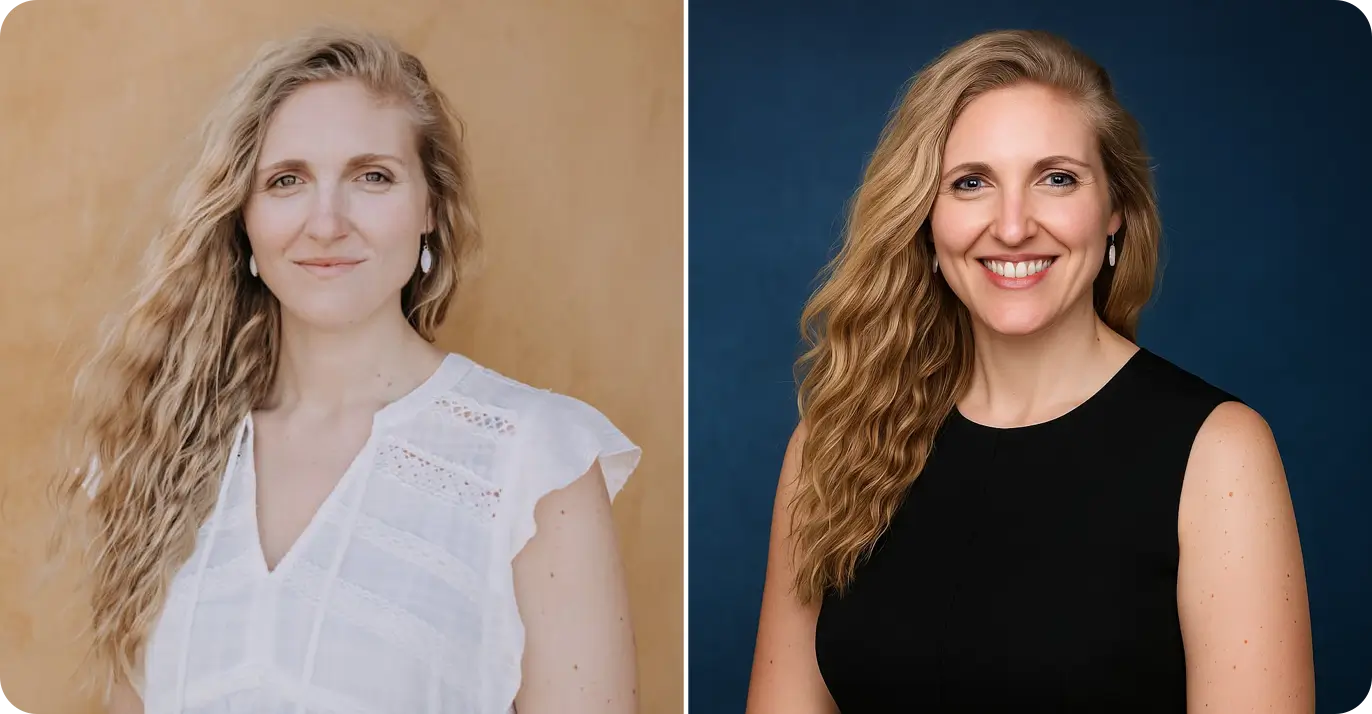
Acting look example 1
Complete both tool and report layers in one continuous workflow.
Choose look type, role emphasis, and submission target before generation.
Run the tool to get readiness score, look variants, and format matrix.
Fix policy, retouch, or timing risks before final submission.
Copy the summary/checklist, submit, then iterate using scenario outcomes.
Decision-focused questions before you submit or pay for a session.
Continue with cost planning, safety checks, or pose optimization.
Use your validated look and format plan to generate studio-grade variants in one run.